
Invited Speakers
Home > International Conference > Invited Speakers
- Plenary Lecture Ⅰ
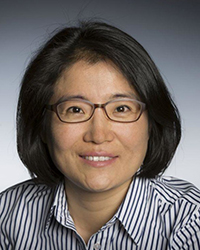 Mihyun Kang
-
Matchings on random graphsWe will briefly overview classical and recent results concerning matchings on random graphs. We will also discuss a connection between the matching number of sparse random graphs and the rank of sparse random binary matrices.
- Plenary Lecture Ⅱ
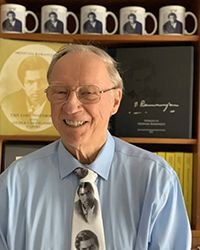 Bruce Berndt
-
RAMANUJAN’S NOTEBOOKS AND LOST NOTEBOOKSrinivasa Ramanujan is universally regarded as India’s greatest Mathematician. After a brief biography of Ramanujan, I will provide histories of Ramanujan’s earlier notebooks and his later lost notebook, with some examples from each of them. Along with these histories, I will relate how I began my interest in the notebooks. If time permits, Gauss’s unsolved ‘Circle Problem’ and Ramanujan’s relation with it will be discussed.
- Plenary Lecture Ⅲ
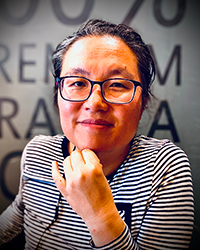 Juhi Jang
-
Dynamics of Newtonian starsIn astrophysical fluid dynamics, stars are considered as isolated fluid masses subject to self-gravity. A classical model of a self-gravitating Newtonian star is given by the gravitational Euler-Poisson system. In the talk, I will review some recent progress on the local and global dynamics of Newtonian star solutions and discuss self-similar Newtonian gravitational collapse and stability of the Larson-Penston solution for isothermal stars.
- Plenary Lecture Ⅳ
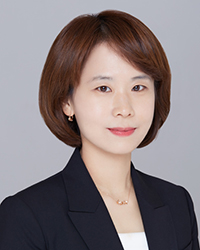 Seonhee Lim
-
dynamics, number theory and post-quantum cryptographyFrom ancient times to the present day, we have always used rational numbers to approximate irrational ones. But what kind of sequences of rational numbers provide good approximations to irrationals? Are there rational numbers that approximate particularly well, or irrational numbers that resist good approximation? How well can a matrix with irrational entries be approximated by a matrix with rational entries?
These questions are deeply connected to lattices, which are used in post-quantum cryptography, and to certain geometric spaces of lattices. In this lecture, we will explore these spaces, orbits closures in them, and explain how dynamics of "lattices" relates to rational approximation. - Award Lecture
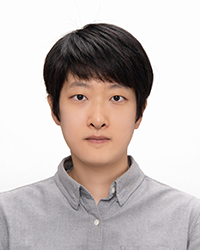 Hyangdong Park
-
Shocks and contact discontinuities for the steady Euler systemThere are two types of discontinuous transition phenomena in inviscid compressible flows, shocks and contact discontinuities. We will discuss the existence and stability of shocks and contact discontinuities for the steady Euler system. The Helmholtz decomposition method and the iteration method for 2-D and 3-D axisymmetric flows with nonzero vorticity will be introduced.
- Public Lecture Ⅰ
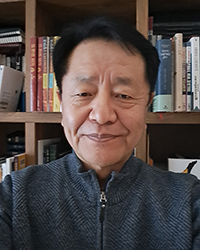 Youngmok Jeon
-
The Past, Present of Applied Mathematics and Toward the Era of AI & QC.In this talk, I will begin with a historical review of applied and industrial mathematics, tracing its origins back to ancient Greek. The advancement of computational power in the 20th century shifted modern applied mathematics toward computational modeling, optimization, and cryptography, which enabled breakthroughs in science and industry.
Now, at the dawn of the Artificial Intelligence (AI) and Quantum Computing (QC) era, applied mathematics is undergoing another transformative shift. AI, powered by deep learning is revolutionizing data-driven modeling, while QC promises to redefine problem-solving in optimization, cryptography, and beyond. We explore how these emerging technologies will reshape mathematical research and applications, presenting both unprecedented opportunities and new challenges. - Public Lecture Ⅱ
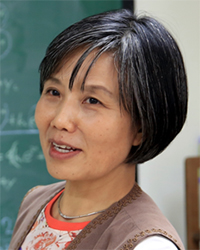 Seonja Kim
-
Maps of algebraic curves to projective spaceLet C be a compact Riemann surface, which is a smooth irreducible complex algebraic curve. In 1865, B. Riemann and G. Roch gave a theorem on the dimension of the space V of meromorphic functions with prescribed zeros and allowed poles. Such a space V of functions without common zero gives rise to a map of C to the projective space P(V ). Further, if the degree of the map equals one then that image is a kind of realization of C in P(V ). It is an interesting classical problem to describe all the ways in which a given smooth algebraic curve could be mapped into a projective space with xed degree. The theory related this problem is called the Brill-Noether theory. A. Brill and M. Noether established the basis of this theory in the 1870s. In this talk we will consider basic notions mentioned above together with their background or context, and then brie y review some results related to the Brill-Noether theory.